

- Views and opinions expressed are however those of the author(s) only and do not necessarily reflect those of the European Union or the European Education and Culture Executive Agency (EACEA). Neither the European Union nor the granting authority can be held responsible for them.
Project title: Cultural Bridges Across the Mediterranean
Project acronym: BRIAM
Programme: Erasmus+ KA210-ADU
Project code: 2024-1-ES01-KA210-ADU-000256311
Duration: 1 November 2024 – 28 February 2026
Coordinator: Labyrinth Catalunya, Spain
Partners: Music Steps, Greece; Kopanica, Belgium; Uşak Public Education Centre, Türkiye
BRIAM – Erasmus+ Project Results
The BRIAM project, “Cultural Bridges Across the Mediterranean” (Project Code: 2024-1-ES01-KA210-ADU-000251084), was an international Erasmus+ KA210-ADU partnership dedicated to adult education, intercultural dialogue, and the shared musical heritage of the Eastern Mediterranean. The project was implemented from 1 November 2024 until 28 February 2026. It brought together partners from Spain, Greece, Belgium, and Türkiye with the common goal of using modal music as a bridge between cultures, communities, and generations.
At the heart of the project was the belief that music can function as a living educational tool. BRIAM explored the common roots of Byzantine music, Ottoman music, Greek traditional music, and broader Eastern Mediterranean modal traditions. Through seminars, rehearsals, concerts, online learning, and open educational resources, the project created opportunities for adult learners, musicians, educators, and local communities to meet through a shared artistic language.
PROJECT RESULTS
The BRIAM project produced a series of educational and artistic outputs that remain freely accessible to the public:
- Online educational platform with open learning material
- A series of 10+ virtual seminars with international musicians and researchers
- Audiovisual documentation of concerts, rehearsals and seminars
- Music scores and educational resources on modal music
- The creation of the Estoudiantina of Cyclades orchestra
- Public concerts and communication events
All results remain openly accessible through the Estoudiantina Cyclades website and YouTube channels: https://estoudiantinacyclades.com/
Project objectives
The main objective of BRIAM was to transform the shared modal musical heritage of the Eastern Mediterranean into a tool for adult education, intercultural learning, and artistic collaboration. The project aimed to promote understanding, acceptance, and respect among people from different countries and backgrounds through traditional music, while also stimulating creativity, research, and personal fulfilment among participants.
The project also sought to develop educational material for intercultural education, encourage participatory research on local musical traditions, and create long-term digital resources that could remain available after the end of the project. A central sustainability goal was to ensure that the Estoudiantina of Cyclades and the digital educational platform would continue to serve the local community beyond the formal closure of the programme in February 2026.
Partnership
BRIAM was developed through the cooperation of four organisations:
Labyrinth Catalunya, Spain
Project lead. Responsible for strategic management, online seminar coordination, and overall support to the international partnership.
Music Steps, Greece
Key partner for the creation and development of the Estoudiantina of Cyclades, the curation of educational material, the development of the virtual platform, and the organisation of local seminars, rehearsals, and concerts in Greece.
Kopanica, Belgium
Responsible for the first in-person seminar and coordination meeting in Belgium and for contributing its valuable experience in transnational artistic exchange and ensemble work.
Uşak Public Education Centre, Türkiye
Contributed to repertoire development, educational work, and joint activities linked to traditional and modal music.
Main activities
- First in-person seminar and coordination meeting in Belgium
One of the first major public milestones of the project was the in-person seminar and coordination meeting in Belgium, planned for 22–24 March 2025. This activity brought together the partners for direct exchange, project coordination, and educational presentations on the common roots of Mediterranean music.
Link page: https://estoudiantinacyclades.com/1st-in-person-meeting-in-brussels-seminar-concert/
- Creation and development of the Estoudiantina of Cyclades
A major output of BRIAM was the establishment and growth of the Estoudiantina of Cyclades, a students’ and teachers’ orchestra based in Syros. According to the project design, this ensemble was created as a living bridge between the musical traditions of the Mediterranean and as a core vehicle for rehearsals, performances, intercultural learning, and community engagement. On the website, Estoudiantina of Cyclades is presented as a musical ensemble dedicated to connecting traditional music with the present through education, collaboration, and local community engagement.
- Development of pedagogical resources and the virtual platform
Another central activity of the project was the development of pedagogical resources and the creation of an online platform where seminars, videos, recordings, scores, and theoretical material could be gathered and shared openly. The original project plan explicitly described the production of recordings, videos, notes, music theory material, music sheets, and multilingual educational content for long-term use. The current website already presents this vision through its educational sections, scores, online learning hub, and music theory resources. (
Link page: https://estoudiantinacyclades.com/community/education/scores-greek-traditional-music/
Link page: https://estoudiantinacyclades.com/community/education/
- Virtual seminars and Music Talks
BRIAM included a substantial online educational dimension. The project application planned a series of about 10 virtual seminars involving teachers, musicians, and researchers from the partner countries. On the website, this appears in the form of the “10+1 Music Talks: Conversations on Modal Music Today,” organised by Christos Barbas and Eleni Kallimopoulou, presented as part of the Erasmus+ programme “Briam: Bridges Across the Mediterranean.” The page lists eleven talks with dates from 7 April 2025 to 2 February 2026 and provides YouTube links for public viewing.
- Link page: https://estoudiantinacyclades.com/community/education/virtual-seminars-online-learning-hub/
- Second in-person seminar in Syros
The project application also included a second in-person seminar in Greece, planned for 10–12 October 2025 on the island of Syros. This seminar was designed as a follow-up to a full year of project activities and as an opportunity to deepen the educational process through music practice, peer learning, and the sharing of findings related to traditional music and its wider cultural meanings. Link page: https://estoudiantinacyclades.com/3rd-concert-photos-and-videos/
- Final communication events and concerts
The project concluded with communication and dissemination actions in Greece and Spain. The application described final public events that would communicate the project’s results to local communities through presentations, concerts, and public sharing of the educational material developed. The current website already includes concert pages, photos, videos, and educational presentation content, showing that the project’s public-facing artistic and educational dimension became a visible part of the platform.
Open educational results
BRIAM produced a growing body of open educational resources and artistic documentation. These results include:
Educational texts and theory resources
The website currently hosts educational material such as “Bridges of Sound: Makams and the Modes of Byzantine Music,” “Easy Music Theory: A Beginner’s Guide to Understanding Music from Scratch,” and “Exploring the Depths of Music Theory: From Basics to Advanced Concepts.” These pages support the project’s adult education mission and make musical knowledge accessible to a broad audience.
Link page: https://estoudiantinacyclades.com/community/education/
Scores and music material
The site includes a dedicated section titled “Scores – Greek Traditional Music,” reflecting the project’s commitment to providing practical learning material for musicians, teachers, and ensembles.
Link page: https://estoudiantinacyclades.com/community/education/scores-greek-traditional-music/
Videos and audiovisual resources
The website points visitors to YouTube videos connected with the Music Talks and presents the project as a space where recordings, demonstrations, concerts, and educational videos are made available for public learning and documentation. The original project application also planned audio and video recordings from Spain, Greece, Belgium, and Türkiye as part of the platform results.
Online learning hub
The current website explicitly presents itself as an online learning hub with virtual lessons, seminars, and resources designed to enhance musical skills and knowledge. This directly reflects the virtual platform and free-access educational logic described in the project application.
Concert and meeting documentation
The site menu currently includes pages for the first concert at Apollo Theater on 18 May 2025, the concert-educational presentation of musical instruments in February 2026, and a third concert photo and video page from October 2025, alongside a general “Photos and Videos” section. These pages help document the public artistic life of the project and the work of the Estoudiantina of Cyclades.
Educational hub and useful links
Educational Hub
Here visitors can explore the project’s educational resources, music theory pages, learning texts, and other supporting material for modal music and traditional music education.
Scores – Greek Traditional Music
Here visitors can access score-based material linked to the project’s musical and pedagogical work.
Link page: https://estoudiantinacyclades.com/community/education/scores-greek-traditional-music/
Photos and Videos
This section gathers visual documentation from concerts, rehearsals, meetings, and other project-related activities.
Link page: https://estoudiantinacyclades.com/community/the-importance-of-photos-and-videos-in-modern-communication/
Virtual Seminars: 10+1 Music Talks
This section offers public access to the online seminar series and recordings.
10+1 Music Talks Conversations on Modal Music today
The “10+1 Music Talks” were a key part of the project’s virtual seminar programme, supporting adult education, intercultural dialogue, and knowledge exchange.
The series brought together leading musicians and researchers in modal music, covering topics such as performance, composition, ethnomusicology, and cultural analysis. Each seminar reflected the speaker’s own practice, offering diverse perspectives across traditions and contexts.
Designed as interactive sessions, the seminars encouraged dialogue and peer learning. All talks were recorded and made publicly available online, forming an open educational resource that remains accessible beyond the project’s duration.
YouTube link for all Virtual Seminars:
- 07/04/25 A Vision for Contemporary Modal Music Ross Daly
https://www.youtube.com/watch?v=TTbX9hzm4d8 - 05/05/25 Apples & Oranges? New Encounters for Modal Music & Musicians Sokratis Sinopoulos https://www.youtube.com/watch?v=86LaF7lmxkk
- 02/06/25 Interdisciplinary Approaches to Gesture-Sound Studies Stella Paschalidou https://www.youtube.com/watch?v=IVC0nDlz0cQ
- 30/06/25 The Form of Amane through Rebetiko Recordings Evgenios Voulgaris https://www.youtube.com/watch?v=cB4xyn5JTK0
- 08/09/25 Rhythmical Swing In Greek Music Performance: Giannis Rizopoulos
- 06/10/25 Beyond the Hype: Envisioning Sustainable Futures for Greek Traditional Music Eleni Kallimopoulou https://www.youtube.com/watch?v=IV5sEKPfOH4
- 03/11/25 A Matter out of Place: Greek Music and Politics of Affect
Among the Mizrahi People in today’s Israel Sissie Theodosiou - 01/12/25 Lost Sound Revealed? Ottoman Music Sources & Contemporary Performance Practices Panagiotis Poulos https://www.youtube.com/watch?v=cj05B2GmER8
- 15/12/25 Multi-modalism & the Unlimited Melodic Diversity
in Eastern Music Traditions Markos Skoulios https://www.youtube.com/watch?v=gsQ-MspXqXc - 12/01/26 Iranian Tombak Players: Transformations in Status,
11. 02/02/26 Interactive Technologies in Modal Music Performance Natalia Kotsani https://www.youtube.com/watch?v=JXe5JTm5cu0
12.The Case οf the Rhythmical Feel In The Drama Region https://www.youtube.com/watch?v=W_qq2dQPh2M
Concert pages
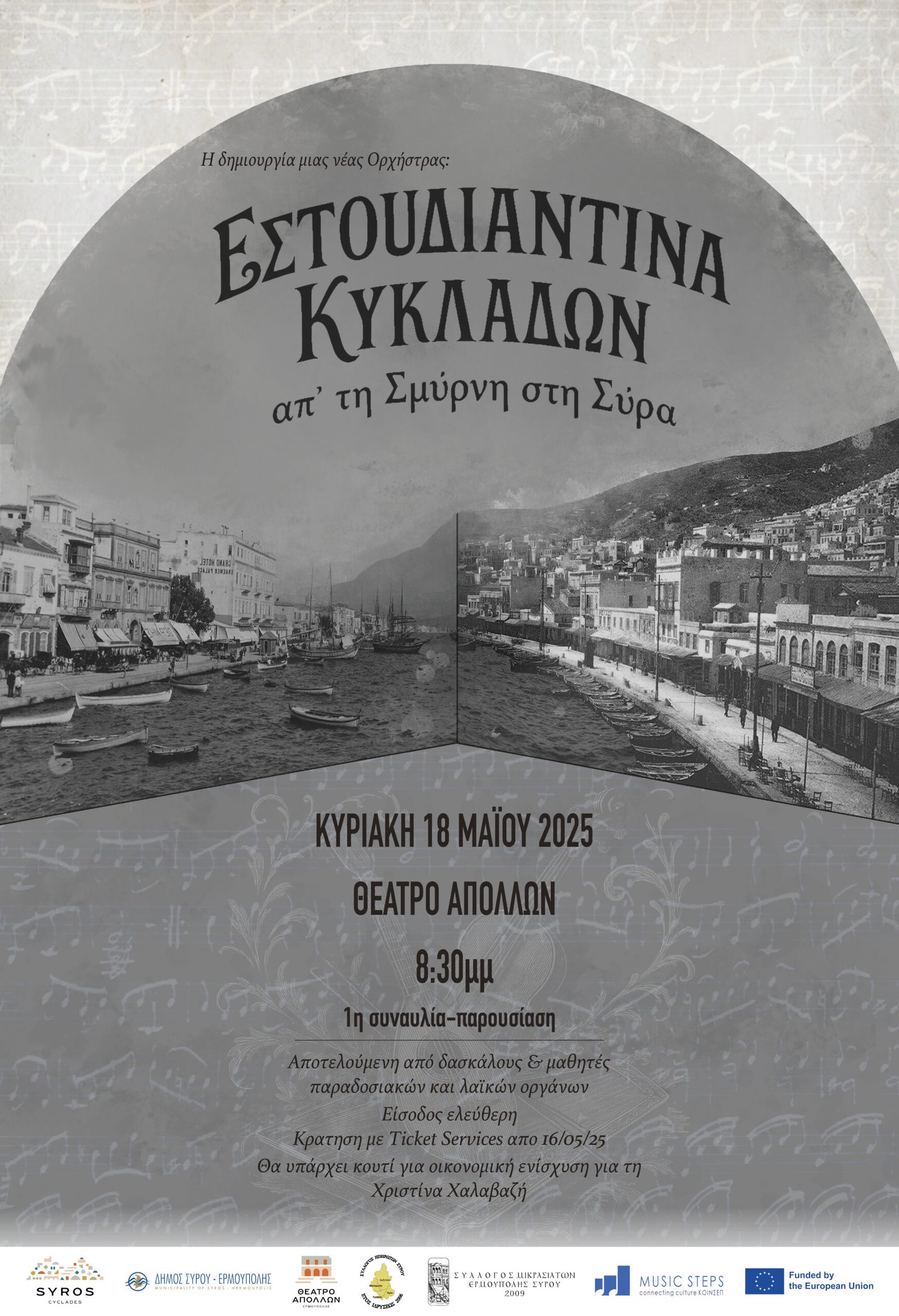
Formation of Estoudiantina Cyclades Concert – Apollo Theater, 18 May 2025
https://estoudiantinacyclades.com/community/formation-of-estoudiantina-cyclades/
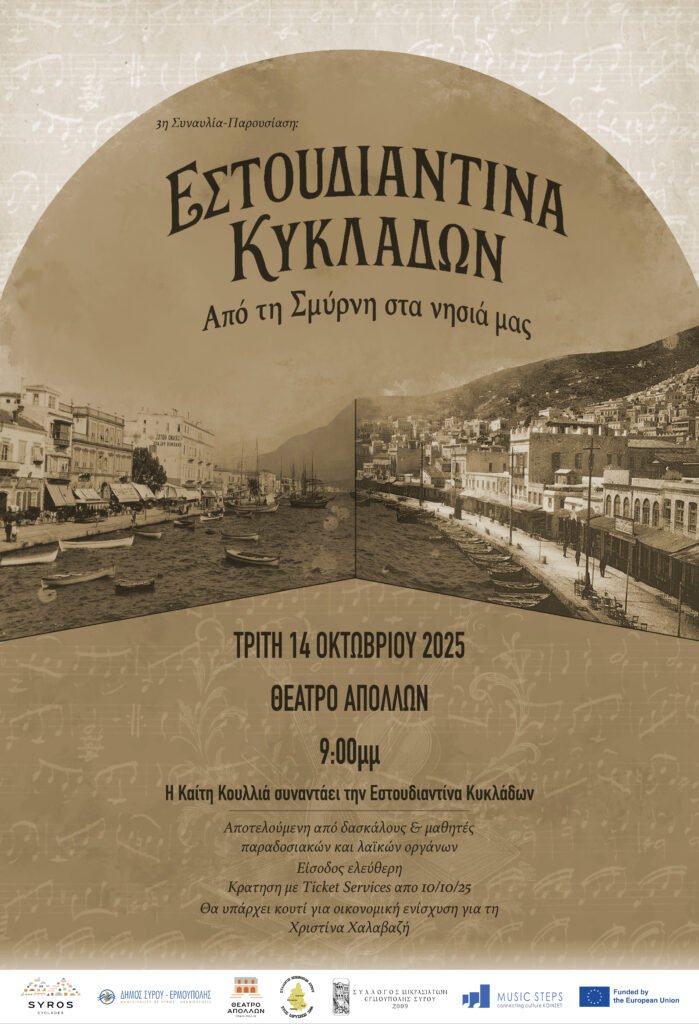
Third Concert Photos and Videos, October 2025
https://estoudiantinacyclades.com/3rd-concert-photos-and-videos/
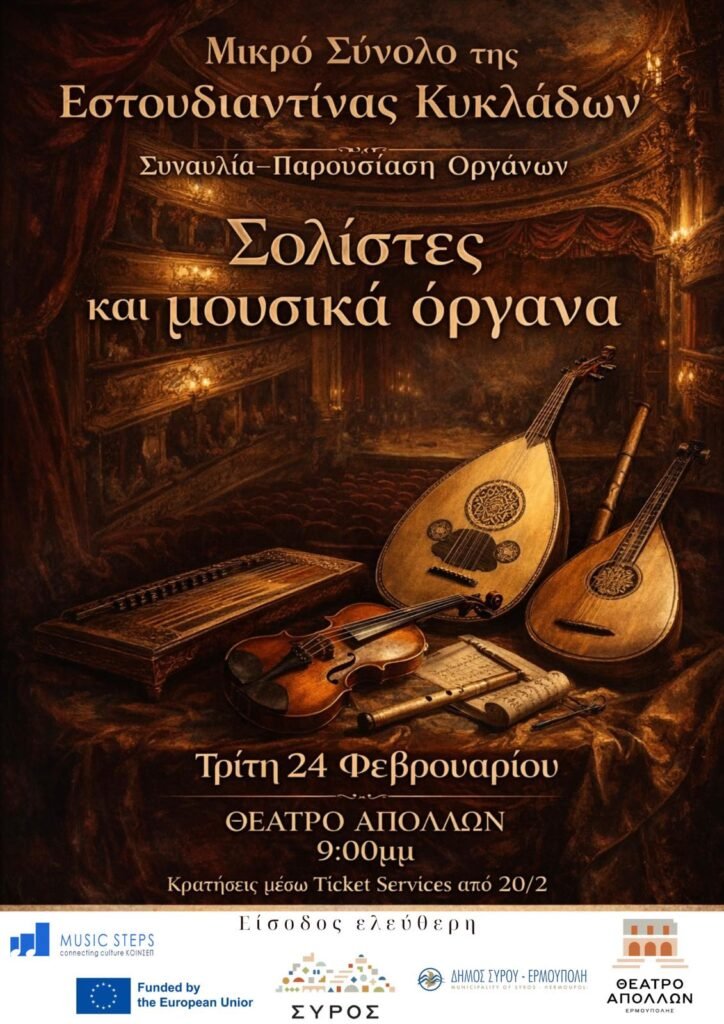
Final Concert-Educational Presentation of Musical Instruments, February 2026
https://estoudiantinacyclades.com/consert-educational-presentation-of-musical-instruments/
Project impact
BRIAM established a coherent international framework where modal music functioned not simply as a subject of study, but as a shared cultural practice connecting musicians, adult learners, educators, and local communities. Through joint repertoire development, critical reflection, blended learning formats, and collaborative performances, the project fostered meaningful intercultural exchange and strengthened transnational artistic dialogue. It positioned modal music as a dynamic field of contemporary practice, bridging tradition with innovation, and reinforcing its role within adult education and lifelong learning.
A central impact lies in the recognition of Eastern Mediterranean musical heritage as a living, evolving knowledge system. Rather than treating this repertoire as archival material, BRIAM supported its transmission through embodied practice, creative reinterpretation, and pedagogical innovation, ensuring its relevance within current artistic and educational contexts.
A particularly significant outcome of the project is the creation and consolidation of the Estoudiantina of Cyclades as a sustainable local cultural nucleus. Initially conceived as a new ensemble embedded within the community of Syros and the Cyclades, it has developed into an active structure that continues to operate beyond the project lifecycle. Its ongoing artistic activity, public presence, and educational role demonstrate a clear continuity of impact, effectively carrying forward the project’s methodologies and values. The current presentation of its digital platform further confirms this long-term sustainability, highlighting its function as both an artistic ensemble and a community-based learning environment.
Sustainability
The sustainability of BRIAM is one of its strongest features. The project has not ended with the final administrative date. Its results remain available through the website, the educational pages, the score archive, the seminar recordings, and the YouTube documentation. The project’s open-access model allows musicians, educators, students, researchers, and interested audiences to continue using the material freely after the end of the funded period.
A key sustainability outcome of the project is the continuation and institutional development of the Estoudiantina of Cyclades. Building on the experience gained during the project, the ensemble is evolving into an official non-profit association (cultural society), ensuring its long-term operation, artistic activity, and educational role within the local community and beyond.
This transition from a project-based ensemble to a formal organisation represents a significant step in guaranteeing the long-term impact of BRIAM. The Estoudiantina will continue to organise rehearsals, concerts, educational activities, and collaborations, maintaining and expanding the network created during the project.
The initiative is open to musicians, educators, and supporters who wish to participate in its future development. Those interested can express their interest through the following form:
https://forms.gle/A4yRaGepoxGSJTfS8
Through this continuation as a structured organisation, the Estoudiantina of Cyclades is expected to function as a sustainable cultural and educational hub, preserving and promoting the shared musical heritage of the Eastern Mediterranean while fostering new artistic and educational initiatives.
The website itself reflects this sustainability goal: that the local community and the musicians of Syros will embrace the Estoudiantina and ensure its operation well beyond the programme’s completion in February 2026.